Skip to content

StatoraUptime monitoring and status pages, on your own infrastructure

Statora checks your websites, APIs and servers around the clock, rolls them up into the services your users care about, and keeps everyone informed with branded status pages, incident updates and maintenance notices, all from a single container you run yourself.

Statora

See it before you install it ​

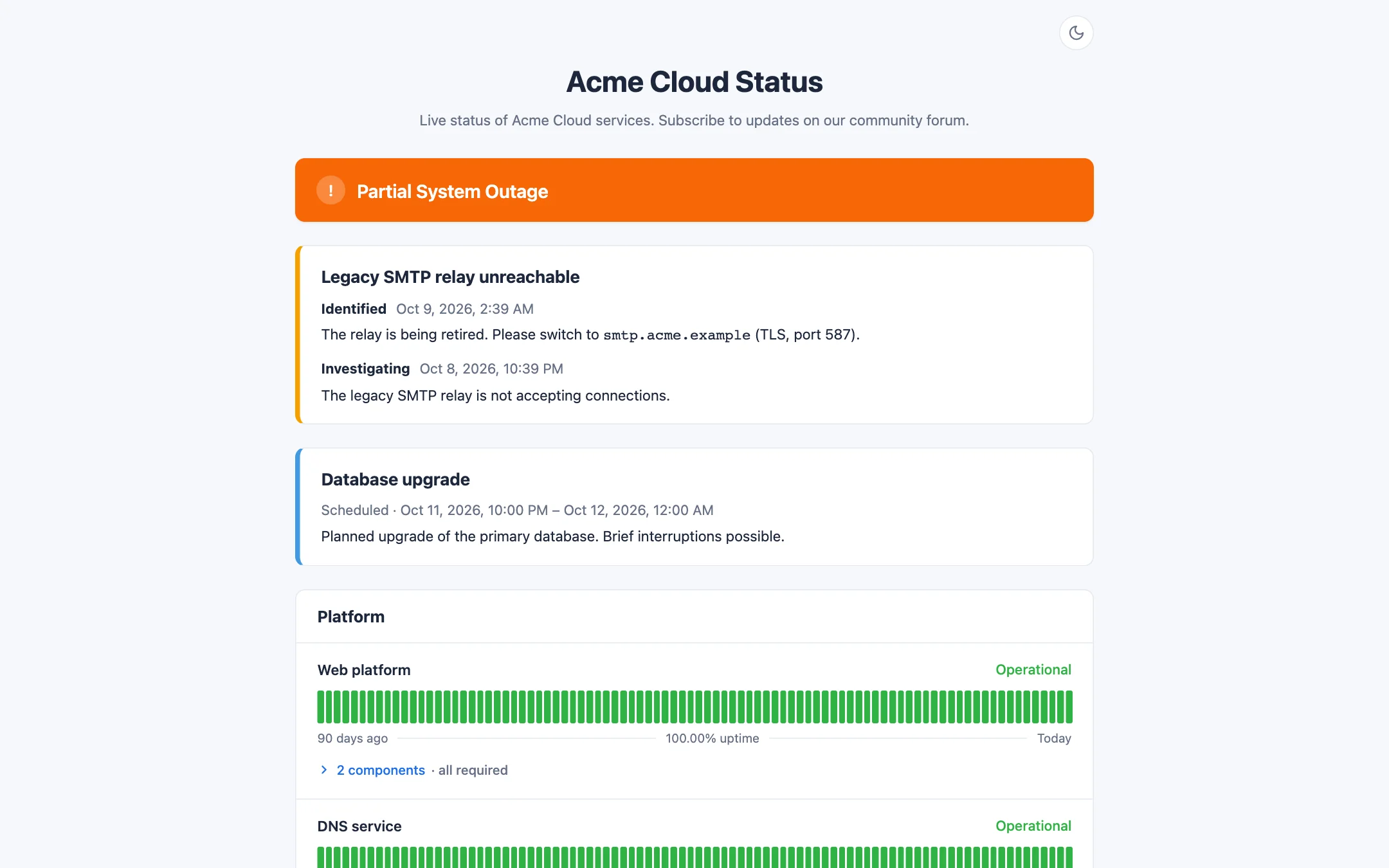
Public status page with an active incident, maintenance notice and uptime bars
The public status page: overall state, incidents, maintenance and 90 days of history.
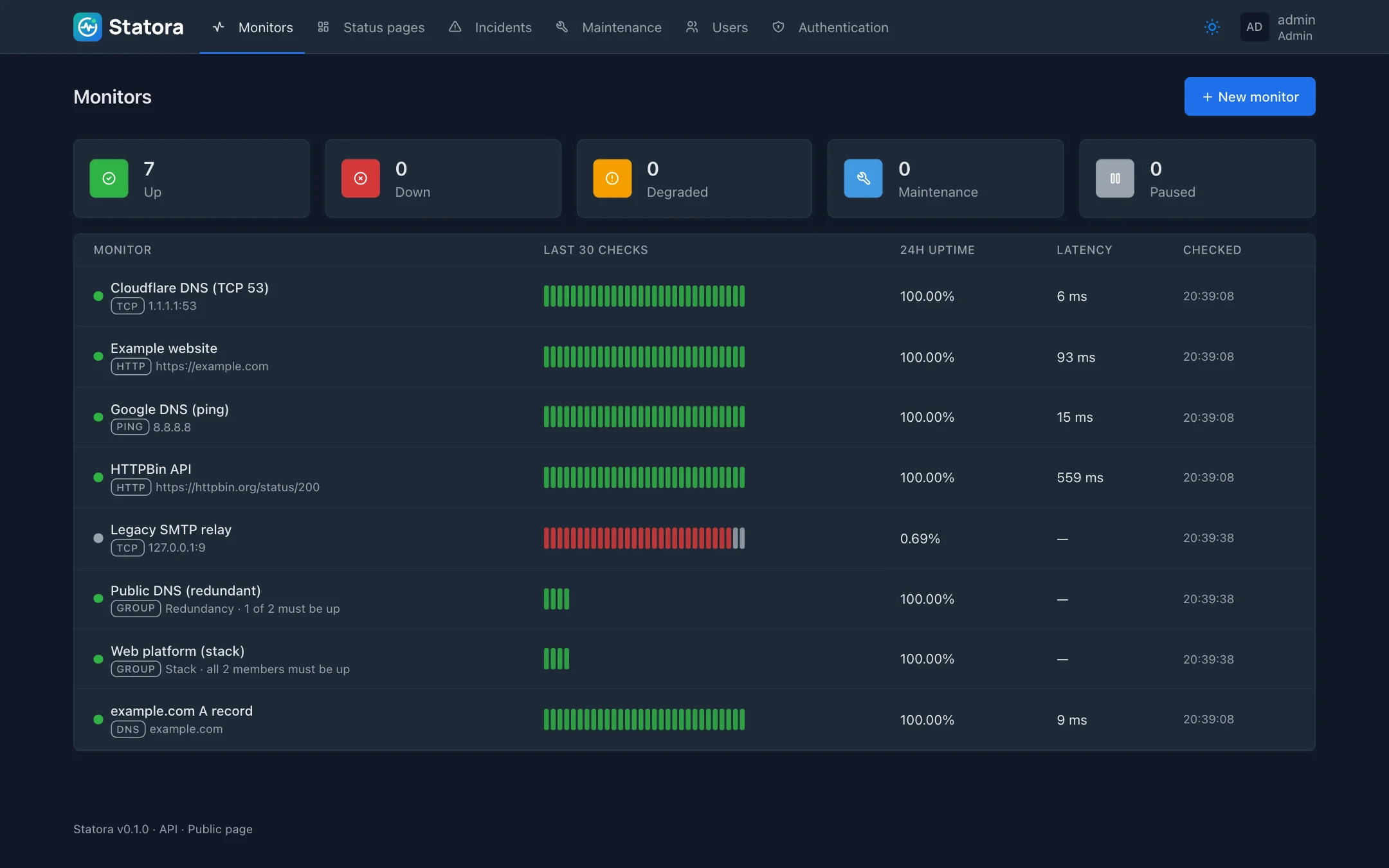
Admin dashboard listing monitors with their recent checks, uptime and latency
The admin dashboard refreshes itself, so it can stay open on a wall screen.

More screenshots →

Try it in two minutes ​

You need Docker (or Podman) with the Compose plugin.

bash
curl -fsSLO https://raw.githubusercontent.com/timothestoifl24/statora/main/docker-compose.yml
curl -fsSL https://raw.githubusercontent.com/timothestoifl24/statora/main/.env.example -o .env

# Set a secret key and a database password
sed -i.bak "s/^STATORA_SECRET_KEY=.*/STATORA_SECRET_KEY=$(openssl rand -hex 32)/; s/^POSTGRES_PASSWORD=.*/POSTGRES_PASSWORD=$(openssl rand -hex 16)/" .env

docker compose up -d
docker compose exec app statora create-admin

Open http://localhost:8000/admin, sign in, and add your first monitor. Want something to look at straight away? docker compose exec app statora seed creates demo monitors, groups and a status page at /s/demo.

The setup guide covers TLS, reverse proxies, plain Docker and Kubernetes.

What this is, and what it is not ​

Statora is uptime monitoring and status pages that you host yourself.

  • Watches your services: it checks websites, APIs, servers, DNS and databases from wherever you install it, and groups the checks into the services your users actually depend on.
  • Keeps people informed: it publishes branded status pages, with incident updates and planned maintenance, and keeps 90 days of history.
  • Fits your setup: your team signs in with the accounts it already has (LDAP, OIDC or SAML), and your automation gets a complete REST API.
  • Your infrastructure, your data: one container, plus your own PostgreSQL and Redis.

Statora is not a metrics or APM platform. It doesn't scrape Prometheus, trace requests or store logs. It also doesn't check from many locations around the world on its own, though you can run more than one instance. If you need to know whether something works and who should be told, Statora is a good fit. If you need to know why it's slow, pair it with your observability stack.